
Accounting Implications of Local Water Done Well for New Zealand Local Government

Introduction
New Zealand’s Local Water Done Well (LWDW) framework requires every council to determine how it will sustainably deliver drinking water, wastewater, and stormwater services in the years ahead. As part of this reform, councils must prepare a Water Services Delivery Plan and select a service-delivery model that can meet operational, regulatory, and financial expectations.
Water Services Delivery Model Options under LWDW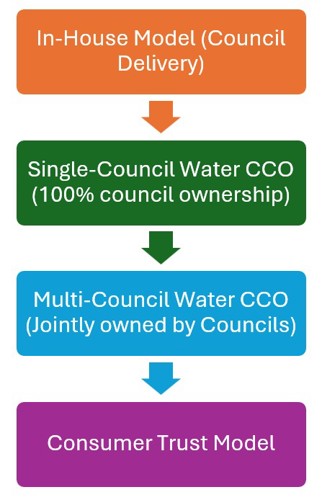
Whichever service-delivery model a council selects, those responsible for the council’s accounting and financial-management functions must carefully consider the accounting implications associated with that choice. Each model carries distinct consequences for financial reporting, valuation, asset management, consolidation, and long-term financial planning.
While accounting may not be the primary focus for many councils during the early stages of reform—where operational capability, workforce planning, and governance arrangements naturally attract immediate attention—a robust accounting foundation is indispensable. The quality of accounting policies, asset-valuation methodologies, consolidation processes, and financial-information systems will directly influence the smoothness of the transition and the credibility of financial reporting in the first years of operation.
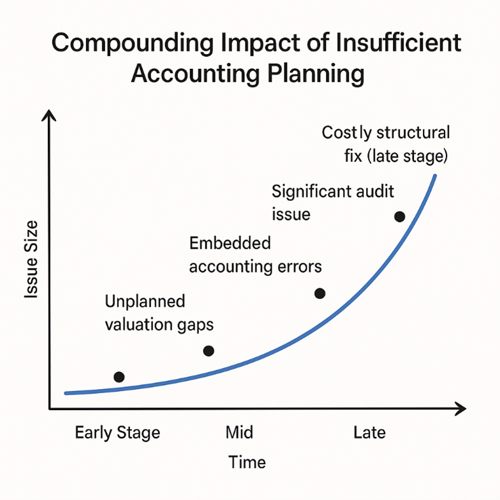
As with many complex restructures, insufficient planning at the outset can result in issues that compound over time. Gaps in valuation work, misaligned accounting policies, poorly planned asset transfers, or weak chart-of-accounts design can become embedded in the new entity’s financial architecture. These issues often require significantly more effort and cost to correct later—if they can be corrected at all—or may instead force councils and the new CCO to operate with enduring limitations that introduce ongoing risk, inefficiency, and elevated long-term compliance costs.
Two Paths, Two Accounting Realities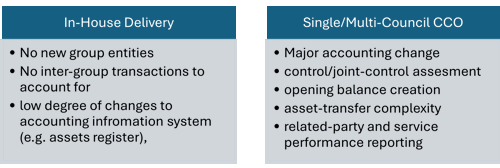
For councils choosing to retain water services internally, the accounting implications are comparatively modest—chart-of-accounts refinements, enhanced cost-allocation practices, clearer capitalisation rules, and improved reporting to meet economic-regulation expectations. These refinements are important, but they do not fundamentally alter the council’s group structure.
However, for councils adopting a single-council or multi-council Water Services CCO, the accounting, consolidation, and financial-reporting implications become significantly more complex.
Once a council determines whether it controls, jointly controls, or influences the new entity under PBE IPSAS 35, the next critical decision concerns the reporting requirements of the Water CCO itself—including the choice of financial-reporting framework (PBE IPSAS or NZ IFRS) and the development of consistent accounting policies for infrastructure measurement, depreciation, revenue classification, financial instruments, and service-performance reporting.
Councils must also consider the implications for funding and financing. Water Services CCOs will often rely on the New Zealand Local Government Funding Agency (LGFA) for borrowing, and LGFA’s information requirements, covenants, and financial-ratio expectations must be incorporated at the design stage. In addition, the new entities may need access to alternative or supplementary sources of finance—such as bank facilities, project financing, targeted user-charges, or long-term capital-funding arrangements—which place further demands on the quality, consistency, and transparency of financial information from the outset.
Only after these foundational decisions are made can councils address the more detailed implications: the transfer and valuation of infrastructure assets, the treatment of intra-group construction and internal margins, the classification of funding streams, and the expanded related-party and service-performance disclosures required. For multi-council structures, additional complexity arises from harmonising valuation methodologies, asset registers, depreciation practices, and financial-policy settings across multiple authorities.
This article provides a roadmap for the key accounting steps councils may need to consider when establishing Water Services CCOs: View PDF
--
Article by Associate Director, Peyman Momenan